
Grazerite
Herbivorous bovine race from the planet Grazer in the Alpha Quadrant. Grazerites are well known for being pacifists and avoiding conflict. On their world the herbivorous herd animals evolved intelligence to become the dominant species. The population of Grazer is over 10 billion, the planet featuring vast cities dotted across vast meadow continents.
Grazer is located in the Alpha Quadrant, near the border with the Tholian Assembly. This strategic location made their world important, being added as a protectorate in the 2260s and Federation members a decade later. Grazerites are gifted with patience and, along with their pacifist nature, make excellent doctors, scientists and counsellors. This is aided by the thoughtful nature they possess, making them ideal for tasks requiring long attention spans and attention to detail.
Grazerite culture consists of the upsol: 100 – 500 individuals who work, live and ruminate together. They rely on the group and not the individual, making the United Federation of Planets an appealing political organisation. Debates and politics are topics close to the heart of Grazerites and they have thrived in the political arena of the Federation. They have been drawn into the bloc along with the Deltans, Betazoids and Vulcans attempting to re-draw the more political Federation ready for the 24th Century.
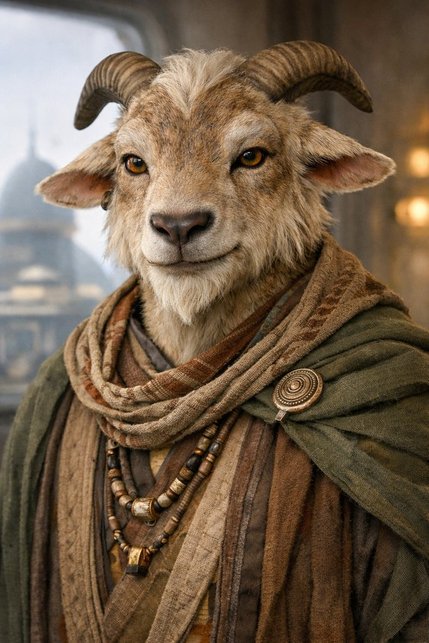 Grazerites: Species Summary & Cultural Variations
Species Identity & Core Traits
Grazerites are a herd-evolved, ungulate-derived species from Grazer Orin. Their psychology and culture are shaped by ancient herd dynamics: vigilance, cooperation, cyclical leadership, and environmental harmony.
Physiology (General)
- Herbivorous ungulate ancestry (bovine, deer, camel, or highland cow depending on clan).
- Horizontal pupils, strong peripheral vision, and high motion sensitivity.
- Robust social pheromone signalling.
- Clothing and accessories act as social language, not decoration.
Cultural Foundations
- Herd Continuity — individuals see themselves as links in an ancestral chain.
- Vigilance — the “Watcher’s Eye” spiral symbol appears everywhere.
- Cooperation — clans function as micro-herds with rotating leadership.
- Environmental Harmony — architecture, clothing, and rituals reflect ecological balance.
Clothing Symbolism (Species-Wide)
Grazerite attire is a communication system.
Materials
- Wool layers ? protection, communal warmth.
- Leather trim ? ancestral survival memory.
- Plant-fiber weaves ? stewardship of land.
Patterns
- Spirals ? cyclical leadership, vigilance.
- Chevrons ? herd movement, migration.
- Grids ? guild affiliation.
Accessories
- Spiral brooch (right shoulder), Watcher’s Eye, vigilance.
- Beaded necklaces, milestones, migrations, harvests.
- Herd rings (ear piercings), clan identity and adulthood.
Highland Clans (Highland Cow Variant)
Adapted to cold plateaus and misty valleys.
Physiology
- Thick shaggy fur, broad frames.
- Slow metabolism for cold endurance.
- Deep harmonic vocalizations (“echo songs”).
Culture
- Stone-and-wool architecture.
- Communal hearths as spiritual centres.
- Silence rituals to honour winter losses.
- Spiral brooches passed down generations.
Forest Clans (Deer-Like Variant)
Agile, sensory-attuned Grazerites adapted to dense woodland.
Physiology
- Slender frames, digitigrade legs.
- Short striped fur for camouflage.
- Large mobile ears; exceptional low-light vision.
- Strong spatial memory for forest routes.
Culture
- Silent gestural communication.
- Tree-edge settlements blending into foliage.
- Stripe-based robe patterns.
- Herd rings marking adulthood and independence.
Desert Clans (Camel Variant)
Nomadic Grazerites adapted to arid equatorial belts.
Physiology
- Subdermal hump reservoir under robes.
- Heat-reflective cream or white fur.
- Expandable nostrils for sandstorms.
- Wide hooves for dune traversal.
- Salt-regulating glands for water conservation.
Culture
- Shade-circle rituals.
- Water-mark tattoos for desert crossings.
- Chevron robes symbolizing dune migration.
- Oasis-cluster architecture with spiral courtyards.
Lowland / Bison Variant
Heavy-framed Grazerites adapted to plains and open savannah.
Physiology
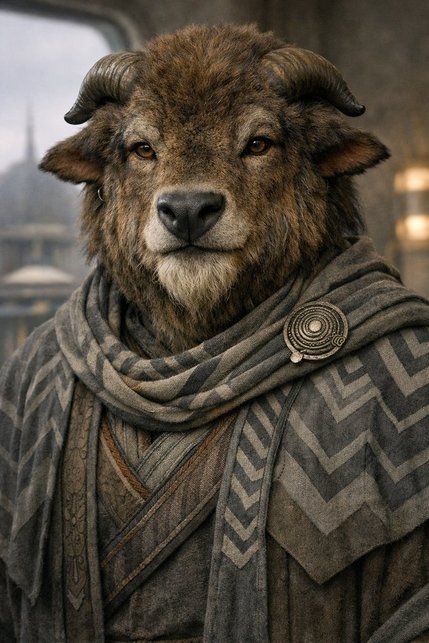
- Thick mane around neck and shoulders.
- Short forward-curving horns.
- Calm, grounded demeanour.
Culture
- Artisan guilds with woven insignia.
- Cooperative plaza-based settlements.
- Clothing in ochre and slate tones.
Grazerites in the Federation (By 2293) Across all clans, Grazerites contribute:
- Ecological diplomacy.
- Environmental engineering.
- Cultural mediation through consensus rituals.
- Slow, deliberate decision-making rooted in herd philosophy.
Their clothing, physiology, and clan traditions help other species read their intentions — making them quietly influential in interstellar politics.
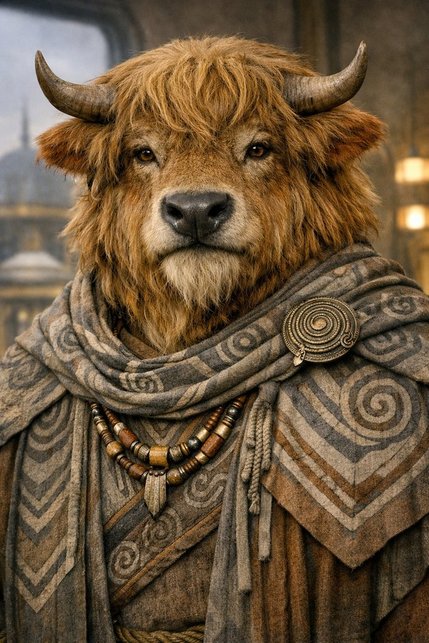 Grazerite Highland clans are the rugged, wind-carved heart of Grazer Orin — communities that evolved in the cold uplands where endurance and cooperation were the only paths to survival. They represent the ancestral memory of the species: stoic, spiritual, and deeply tied to the land’s rhythm
Origins and Environment
The Highland regions of Grazer Orin are vast plateaus and mist-shrouded valleys, where herds once migrated through snow and stone. Clan life developed around seasonal grazing cycles, and even in the modern era, these clans maintain ritual migrations to honor their ancestors.
Grazerite Highland clans are the rugged, wind-carved heart of Grazer Orin — communities that evolved in the cold uplands where endurance and cooperation were the only paths to survival. They represent the ancestral memory of the species: stoic, spiritual, and deeply tied to the land’s rhythm.
The Highland regions of Grazer Orin are vast plateaus and mist-shrouded valleys, where herds once migrated through snow and stone. Clan life developed around seasonal grazing cycles, and even in the modern era, these clans maintain ritual migrations to honor their ancestors.
- Cold-Adapted Physiology — Highland Grazerites have thicker fur, broader frames, and slower metabolisms.
- Stone-and-Wool Architecture — Homes are built from local stone and insulated with woven wool panels.
- Communal Hearths — Central fire circles serve as both meeting places and spiritual centres.
Clan Structure
Each Highland clan is a micro-herd polity, balancing tradition with modern Federation integration.
| Clan Role | Function | Symbolic Garment Element |
|----------------|--------------|-------------------------------|
| Watcher-Elder | Oversees vigilance and diplomacy | Spiral brooch of bronze |
| Forage-Master | Manages food and resource cycles | Chevron-pattern sash |
| Harmony-Keeper | Mediates disputes and maintains emotional balance | Layered robe with muted greens |
| Youth Circle | Apprentices and explorers | Simple wool tunic with clan mark |
These roles rotate seasonally, reflecting the Grazerite belief that no one leads forever — leadership is a shared burden.
Clothing and Symbolism
Highland attire is heavier and more ornate than lowland styles.
- Spiral Embroidery — Represents the eternal cycle of vigilance and renewal.
- Chevron Cloaks — Symbolize the movement of herds through mountain passes.
- Beaded Necklaces — Each bead marks a successful migration or communal harvest.
- Brooches of Aged Silver — Passed down through generations, engraved with the clan’s spiral crest.
Cultural Traits
Highland Grazerites are known for their quiet resilience and ritualized stoicism.
- Silence Rituals — Periods of communal silence to honor ancestors lost to winter.
- Echo Songs — Deep-throated harmonic chants that mimic wind through valleys.
- Stone Offerings — Small cairns built to mark safe paths and herd routes.
Role in Federation Politics (By 2293)
Though remote, Highland clans exert quiet influence through their Watcher-Elders, who often serve as advisors in Federation ecological and cultural councils.
- They advocate slow diplomacy, environmental stewardship, and ritualized consensus.
- Their caution and endurance make them valued mediators during crises.
- Highland Grazerites are often seen as the spiritual backbone of their species — the ones who remind the Federation that survival is a collective act.
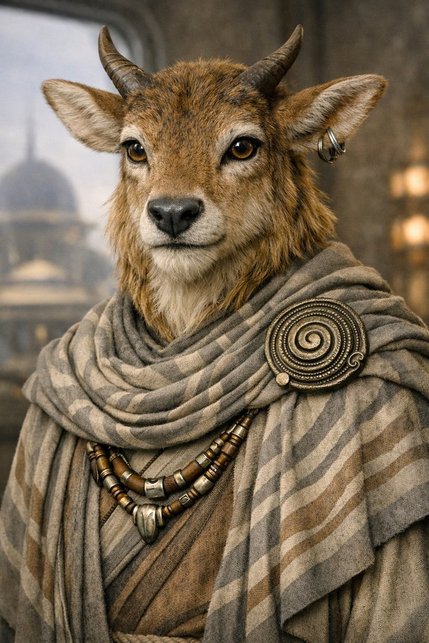 Grazerite Forest Clan:
- Slender Frame — Their bodies are lighter and narrower than highland or lowland Grazerites, optimized for weaving through trees and uneven terrain.
- Digitigrade Limbs — Long, springy legs with split hooves allow silent movement and precise footing.
- Adaptive Fur — Short, fine fur with subtle striping provides camouflage in dappled forest light.
- Enhanced Auditory Range — Their ears are larger and more mobile, capable of pinpointing faint rustles or distant calls.
- Low-Light Vision — Their eyes are amber or greenish-gold, adapted to twilight conditions with exceptional motion detection.
Neurological and Sensory Traits
- Reflexive Awareness — Forest Grazerites process environmental changes almost subconsciously, reacting to sound and movement before conscious thought.
- Pheromonal Signaling — They emit faint scent markers to maintain herd cohesion in dense foliage.
- Spatial Memory — Their hippocampal structures are enlarged, allowing them to memorize complex forest routes and seasonal migration paths.
Cultural and Behavioural Implications
These physiological traits shape their forest-clan culture:
- Silent Communication — Gestural and pheromonal cues replace spoken words during hunts or rituals.
- Tree-Edge Settlements — Homes are built into natural clearings, blending with the environment.
- Stripe Symbolism — Their natural markings inspire robe patterns and clan insignia, representing balance between concealment and identity.
- Herd Ring Tradition — Ear piercings mark adulthood and the ability to navigate the forest independently.
Role in Federation Society (By 2293)
Forest Grazerites often serve as ecological advisors, xenobotanists, and diplomatic scouts. Their physiology makes them ideal for exploration and environmental monitoring.
- They advocate symbiotic planetary management — treating ecosystems as living herds.
- Their calm, observant demeanor earns them reputations as quiet strategists in Federation councils.
 Grazerite Desert Clan:
Grazerite desert physiology is a masterpiece of evolutionary endurance — a blend of camel-like resilience and herd-born cooperation, perfectly adapted to Grazer Orin’s scorching equatorial plains.
Anatomical Adaptations
- Subdermal Hump Reservoir — Located beneath the upper back, this fatty organ stores water and nutrients, allowing survival for weeks without external hydration.
- Heat-Reflective Fur — Their fur is short, fine, and pale cream or white, reflecting sunlight while insulating against heat.
- Expandable Nostrils — Adapted to filter dust and conserve moisture; they can close during sandstorms.
- Wide Hooves — Broad, cushioned hooves prevent sinking into sand and dissipate heat from the ground.
- Salt-Regulating Glands — Specialized sweat glands recycle electrolytes, minimizing water loss.
Neurological and Sensory Traits
- Thermoregulatory Awareness — Their hypothalamic structures allow precise control of body temperature, enabling activity during extreme heat.
- Mirage Perception — Enhanced visual acuity helps distinguish real movement from heat distortion — vital for navigation and predator detection.
- Pheromonal Tracking — Desert Grazerites emit faint scent markers that persist in dry air, guiding herds across vast dunes.
Cultural and Behavioural Implications
Their physiology shapes a nomadic, cooperative culture centered on endurance and resource sharing.
- Shade-Circle Rituals — Communal rest periods under shared canopies symbolize unity and survival.
- Water-Mark Tattoos — Faint blue markings on the neck denote successful crossings of major deserts.
- Herd Ring Identification — Ear piercings serve as clan identifiers, often engraved with migration symbols.
- Chevron Robes — Clothing patterns mirror dune formations, representing adaptability and motion.
Role in Federation Society (By 2293)
Desert Grazerites are valued as logistical experts, terraforming consultants, and survival instructors.
- They specialise in arid-world colonisation and water-recycling technologies.
- Their calm, methodical demeanor makes them ideal for long-duration missions in harsh environments.
- Many serve as Federation environmental engineers, advocating sustainable resource use and herd-based ecological ethics.
Grazerite desert architecture is a triumph of adaptation — a blend of ecological engineering and spiritual design that mirrors the dunes themselves. Every structure is built to breathe, shade, and endure, reflecting the clan’s philosophy that shelter must harmonize with the land rather than dominate it.
Structural Principles
- Thermal Harmony — Buildings are oriented to minimize solar exposure, using curved walls and recessed courtyards that trap cool air.
- Sand-Flow Integration — Foundations are flexible, allowing structures to shift slightly with dune movement instead of resisting it.
- Layered Ventilation — Roofs feature porous stone lattices and woven fiber panels that vent heat while filtering dust.
Materials and Construction
| Material | Source | Symbolism |
|---------------|------------|---------------|
| Compressed Sandstone | Local dunes | Endurance and memory of the land |
| Palm-Fiber Weave | Desert oases | Flexibility and cooperation |
| Bronze Fixtures | Clan forges | Vigilance and continuity |
| White Clay Plaster | Riverbeds | Purity and reflection of light |
Walls are thick but hollow-cored, creating natural insulation. The inner chambers remain cool even under midday heat.
Cultural Design Elements
- Chevron Motifs — Painted or carved into facades, representing dune migration and herd unity.
- Spiral Courtyards — Central gathering spaces shaped like the Watcher’s spiral, symbolizing communal vigilance.
- Shade Rings — Circular awnings woven from palm fibers, used for rest and ritual.
- Herd-Ring Markers — Metal rings embedded in doorframes to denote clan affiliation.
Settlement Layout
Desert Grazerite towns are clustered oases, each designed around a water-sharing nexus.
- Outer Rings — Nomadic tents and trade stalls.
- Middle Rings — Permanent homes and workshops.
- Inner Core — The Shade Circle, a communal sanctuary for meditation and diplomacy.
Paths between buildings are curved, never straight — a symbolic gesture of humility before the shifting sands.
Federation-Era Adaptations (By 2293)
Modern desert Grazerites integrate solar-reflective alloys and moisture-recycling systems into traditional designs.
- Hybrid Cooling Domes — Combine ancient airflow geometry with Federation tech.
- Bio-woven Fabrics — Living textiles that adjust porosity based on temperature.
- Cultural Preservation Zones — Protected areas where traditional architecture remains untouched.
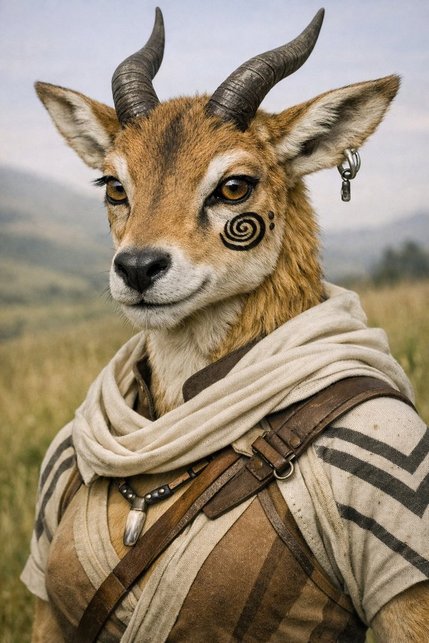 Grazerite Grassland Scout Clan
Grazerite grassland physiology represents the swiftest and most endurance-balanced lineage of the species — evolved for open meadows, rolling hills, and long-distance travel. These Grazerites are the runners and scouts of their world, embodying speed, vigilance, and precision.
Anatomical Adaptations
- Streamlined Frame — Lean musculature and elongated limbs allow sustained sprinting and efficient energy use across vast plains.
- Digitigrade Legs — Long, spring-loaded tendons give explosive acceleration and silent movement.
- Light Fur — Short, tawny or golden fur reflects sunlight and blends with meadow grasses.
- Enhanced Cardiovascular System — Enlarged lungs and dual-chambered hearts support endurance running and rapid recovery.
- Thermal Regulation — Micro-vascular cooling in the ears and neck prevents overheating during long runs.
Neurological and Sensory Traits
- Directional Awareness — Exceptional spatial orientation; they can navigate by subtle wind shifts and grass movement.
- Acute Hearing — Ears detect distant hoofbeats or predators across kilometers.
- Peripheral Vision — Wide field of view allows constant environmental scanning while running.
- Adrenal Reflex Control — They can consciously regulate adrenaline bursts to conserve stamina.
Cultural and Behavioural Implications
Grassland Grazerites form the Scout Clans, known for mobility and communication.
- Watcher’s Eye Tattoo — A spiral mark on the cheek denotes adulthood and readiness for independent scouting.
- Lightweight Clothing — Form-fitting robes and tunics minimize drag and heat retention.
- Single Necklace Tradition — Represents focus and simplicity — one purpose, one path.
- Herd Ring Earring — Marks clan identity and communication link within the herd network.
- Wind-Run Rituals — Ceremonial sprints across meadows at dawn to honour ancestral scouts.
Role in Federation Society (By 2293)
Grassland Grazerites serve as couriers, explorers, and environmental surveyors.
- They specialise in rapid planetary reconnaissance and terrain mapping.
- Their physiology makes them ideal for low-gravity exploration and long-range field missions.
- In diplomacy, they act as swift messengers between colonies — a living embodiment of herd communication and trust.
Grazerite scout traditions are the living heartbeat of the grassland clans — a blend of ritual, discipline, and ancestral reverence that defines their role as the eyes and messengers of the herd. These traditions are not merely practical; they are spiritual affirmations of vigilance and unity.
Core Ethos
- The Watcher’s Path — Scouts see themselves as extensions of the Watcher’s Eye, tasked with perceiving danger before it reaches the herd.
- Speed as Communion — Running is a sacred act; each stride is believed to echo the pulse of Grazer Orin itself.
- Solitude in Service — Scouts travel alone but never feel isolated — their herd’s memory travels with them through scent markers and ritual chants.
Initiation and Symbols
- Watcher’s Eye Tattoo — A spiral mark on the cheek given during adulthood rites; it signifies the bearer’s readiness to act as the herd’s sentinel.
- Herd Ring Earring — Engraved with the scout’s clan sigil, used for identification and communication through subtle metallic resonance.
- Single Necklace Tradition — A cord bearing one pendant, symbolizing focus and the unity of purpose — “one path, one herd.”
Ritual Practices
- Wind-Run Ceremony — Performed at dawn; scouts sprint across the grasslands to renew their bond with the land’s rhythm.
- Echo Chant — A low, rhythmic hum used to synchronize breathing and maintain calm during long runs.
- Silent Return — Upon completing a mission, scouts enter the herd circle without speaking, allowing their presence alone to convey success or warning.
Training and Discipline
- Endurance Trials — Multi-day runs across hills and meadows, testing stamina and mental focus.
- Observation Meditation — Scouts learn to read wind, grass movement, and scent patterns to anticipate threats.
- Memory Relay — A ritualised storytelling exercise where scouts recount routes and encounters to younger trainees, preserving oral maps of the plains.
Role in Federation Era (By 2293)
Grassland scouts serve as planetary couriers, ecological surveyors, and diplomatic envoys. Their traditions have evolved into a philosophy of motion as mindfulness — balancing speed with observation.
- They act as neutral messengers between Grazerite clans and other species.
- Their endurance and calm make them ideal for long-range reconnaissance and environmental monitoring.
- The Watcher’s Eye tattoo remains a respected symbol even in Federation circles — a mark of trust and vigilance.
 Grazerite clothing
Grazerite clothing is never just clothing — it is communication, memory, and herd-identity made visible. Because Grazerites evolved from herd-dwelling bovids, their attire carries layers of symbolism tied to vigilance, unity, ancestry, and cooperative belonging.
Core Principles of Grazerite Clothing Symbolism
Grazerite attire expresses three foundational ideas: Unity — Clothing visually reinforces herd cohesion. Vigilance — Patterns and accessories signal watchfulness. Ancestry — Materials and motifs connect individuals to lineage and cooperative history. Their clothing is not decorative; it is functional social language.
Symbolic Materials
Wool Layers — Represents warmth, protection, and communal care. The thicker the wool, the more the wearer is signaling a role as a “protector” or “stabiliser” within their group. Leather Trim — A nod to ancient survival practices. It symbolises resilience and the memory of predation. Plant-Fibre Weaves — Used by agricultural cooperatives; symbolizes stewardship of land and food security.
Symbolic Patterns
Grazerite patterns are geometric, rhythmic, and often subtly colour-shifted. Spiral Motifs — Represent cyclical leadership and the belief that no one should hold power for too long. Chevron Lines — Derived from herd-movement patterns; symbolise coordinated action. Grid Weaves — Indicate membership in a cooperative guild or agricultural district. Patterns are read almost like
Symbolic Accessories
Sashes — The most important accessory. Colour and knotting indicate cooperative affiliation, seniority, and role.Brooches — Usually metal or carved bone. They symbolize vigilance and are often worn on the right shoulder — the traditional “Watcher’s side.”Beaded Necklaces — Each bead represents a milestone: migrations, harvests, or communal achievements.
Clothing as Emotional Signaling
Because Grazerites rely heavily on body language and pheromonal cues, clothing also communicates emotional states.Muted Colors — Calmness, readiness for consensus, or mourning.Bright Accents — Celebration, communal pride, or diplomatic openness. Layer Adjustments — Removing or loosening layers signals trust and vulnerability.
Clothing in Federation Context (By 2293)Grazerite delegates wear attire that balances tradition with interstellar diplomacy.Federation-Integrated Weaves — Subtle Starfleet-inspired geometric patterns.Neutral Earth-Tone Palettes — To avoid appearing aggressive or overly assertive.Formal Sashes — Indicate the unified position of their internal factions.Their clothing helps other species read their intentions — a quiet but powerful diplomatic tool..
Grazerite ceremonial clothing is a living expression of their herd-born spirituality — a fusion of ritual, ecology, and social harmony. Every thread, clasp, and fold carries meaning, echoing the ancient rhythm of communal vigilance and renewal.
Foundational Symbolism
Ceremonial attire embodies three sacred principles:Continuity of the Herd — The idea that every Grazerite stands as a link in an unbroken chain of ancestors.Harmony with the Land — Materials are sourced from sustainable herding zones, dyed with native flora.Vigilance of the Watchers — The right shoulder brooch and layered cloak recall the ancient sentinels who guarded the herd at night.
Structure and Materials. Ceremonial garments are layered to represent collective protection: Element Symbolism Material. Outer Cloak. Communal unity and vigilance. Heavy wool, often patterned with chevrons or concentric circles. Inner Tunic. Individual duty within the herd. Fine plant-fibre weave, dyed in muted earth tonesSash or BeltCooperative affiliationBraided cords of mixed fibers, sometimes
Brooch or Spiral Pin
The “Watcher’s Eye”Silver or bronze, engraved with spiral or eye motif.
Ritual Colour Palette
Colours are chosen to evoke emotional resonance rather than hierarchy:
- Ash Gray — Memory and mourning.
- Ochre Brown — Fertility and endurance.
- Muted Green — Renewal and ecological balance.
- Bronze Accents — Wisdom and vigilance.
Ceremonial Contexts
Grazerites wear these garments during:
- Seasonal Herd Festivals — Celebrating migrations and harvests.
- Council Inductions — When new representatives join the planetary or Federation councils.
- Watcher Vigils — Night-long ceremonies honoring ancestral protectors.
- Union Gatherings — Cooperative renewal rituals where guilds reaffirm shared purpose.
Symbolic Gestures
During ceremonies, clothing becomes part of the ritual choreography:
- Unfastening the brooch — Symbolizes openness and trust.
- Re-fastening it — Marks the restoration of vigilance.
- Adjusting the sash — Indicates readiness to assume communal responsibility.
- Touching the spiral pin — Invokes ancestral guidance.
Federation-Era Adaptations (By 2293)
Modern Grazerite diplomats blend tradition with practicality:
- Adaptive Weaves — Temperature-regulating fibers for off-world ceremonies.
- Symbolic Integration — Federation insignia subtly woven into the spiral motif.
- Ceremonial Neutrality — Muted palettes to avoid species-specific dominance displays.
The Watcher’s Eye
The Watcher’s Eye is the single most important symbol in Grazerite culture — a visual language of vigilance, adulthood, memory, and communal responsibility. It appears in tattoos, brooches, architecture, clothing, and even the layout of their capital city. Below is a full, structured explanation of its meaning across all clans and contexts.
Core Meaning: Vigilance as Identity
The Watcher’s Eye represents the eternal vigilance of the herd — the idea that safety and prosperity come from constant awareness of the world.
It is always depicted as a spiral, sometimes accompanied by three dots representing:
- Past — ancestral memory
- Present — the living herd
- Future — those yet to join
This makes the symbol a living timeline of Grazerite identity.
Psychological Significance
The spiral is not just decorative — it encodes Grazerite philosophy:
- Cyclical leadership — no one leads forever; roles rotate like the spiral’s curve.
- Shared perception — every Grazerite is responsible for watching over the herd.
- Continuity — life is a loop, not a line; ancestors remain present through memory and ritual.
Symbol in Clothing & Accessories
Across all clans, the Watcher’s Eye appears in:
- Spiral brooches — worn on the right shoulder, the “Watcher’s side.”
- Robes and cloaks — embroidered spirals indicate rank, role, or ritual status.
- Beaded necklaces — central bead carved with a spiral marks major life milestones.
Symbol in Physiology & Tattoos
The most sacred use is the adulthood tattoo worn by scouts, runners, and some clan leaders:
- Placed on the left cheekbone
- A spiral with three dots
- Marks the bearer as a Watcher of the herd
- Signifies readiness for independent travel, vigilance, and responsibility
Grassland scouts are the most famous bearers of this mark.
Symbol in Architecture
The capital city, Orin’s Spiral, is built around the Watcher’s Eye:
- Central spiral tower — the Great Watcher’s Eye monument
- Spiral courtyards — used for diplomacy and ritual gatherings
- Spiral skylights — cast shifting patterns symbolising the movement of the herd
- Arena floors — giant spiral mosaics visible from above
Clan Interpretations
Each clan interprets the symbol through its own environment:
- Highland clans — spiral represents endurance through harsh winters
- Forest clans — spiral symbolises hidden vigilance and silent perception
- Desert clans — spiral echoes dune patterns and long-distance migration
- Grassland clans — spiral marks adulthood and the scout’s sacred duty
- Lowland clans — spiral is a memory of ancient herd formations
Spiritual Dimension
The Watcher’s Eye is believed to be the first symbol ever carved by early Grazerites — a mark left on a stone during a migration thousands of years ago.
It represents:
- The first watcher
- The first herd
- The first shared memory
To bear the symbol is to join that unbroken chain.
The City of Orin’s Spiral
The Grazerite capital city is the living expression of their herd-born identity — a place where vigilance, unity, and ecological harmony are built directly into the skyline. Below is a full, structured description that synthesizes everything you’ve developed about Grazerite culture, clans, and symbolism.
Name & Setting: The City of Orin’s Spiral
The capital sits on a broad plateau where grasslands, highland foothills, and river valleys converge. This location symbolizes the meeting of clans — a neutral ground where every lineage can gather without dominance.
Central Monument: The Great Watcher’s Eye
At the heart of the city stands a colossal monument:
- A multi-layered spiral tower, carved from pale stone and bronze.
- Each ring represents a clan lineage — highland, forest, desert, grassland, lowland.
- The inner core emits a soft amber glow at night, symbolising eternal vigilance.
This is where major ceremonies, adulthood rites, and inter-clan councils are held.
Grand Buildings & Civic Architecture
Grazerite architecture blends organic curves, layered stone, and woven fiber structures.
1. Council Hall of the Herds
A sweeping dome shaped like overlapping horns.
- Interior chambers arranged in concentric circles.
- Delegates sit in rotating positions to reflect shared leadership.
- Spiral skylight casts shifting patterns across the floor.
Council traditions
2. Hall of Clans
A long, terraced building with five wings, each representing a major clan type.
- Highland wing: stone pillars and wool banners.
- Forest wing: living wood arches and leaf-woven screens.
- Desert wing: pale sandstone walls with chevron carvings.
- Grassland wing: aerodynamic curves and open-air corridors.
- Lowland wing: heavy timber beams and earth-tone mosaics.
Clan variations
3. The Spiral Archives
A vast library built downward into the plateau.
- Cool subterranean chambers.
- Memory-stones inscribed with migration histories.
- Scout maps etched into bronze plates.
Scout traditions
Recreational Parks & Herd-Inspired Spaces
Grazerites treat recreation as communal ritual.
1. The Meadow Rings
Circular parks with tall grasses, running paths, and wind-harps.
- Grassland scouts train here.
- Dawn wind-run ceremonies occur daily.
Grassland physiology
2. Highland Hearth Gardens
Terraced stone gardens with warm communal fire pits.
- Highland clans gather for echo-songs.
- Spiral-pattern seating encourages shared warmth.
Highland clans
3. Forest Shadewalks
Tree-lined paths with woven canopy roofs.
- Silent communication rituals practiced here.
- Pheromone-scent markers guide visitors.
Forest physiology
4. Desert Reflection Pools
Shallow water mirrors surrounded by white stone.
- Desert clans meditate here during heat cycles.
- Chevron mosaics ripple across the surface.
Desert physiology
Arenas & Communal Performance Spaces
The Great Migration Arena
A massive open-air amphitheatre shaped like a sweeping crescent.
- Used for herd-dance performances, scout trials, and diplomatic gatherings.
- The floor is patterned with a giant spiral visible from the sky.
- Runners, watchers, and elders perform rituals reenacting ancient migrations.
Grassland scout traditions
The Vigilant Circle
A smaller arena used for:
- Clan competitions of endurance.
- Echo-song harmonics.
- Spiral-cloak ceremonies.
City Layout & Movement
The capital is designed like a living herd:
- Streets curve like migration paths.
- Buildings cluster in “pods” resembling grazing formations.
- Elevated walkways mimic ridge-lines used by ancient watchers.
- Scent-markers and wind-chimes guide navigation.
Everything moves, flows, and breathes like a herd in motion.
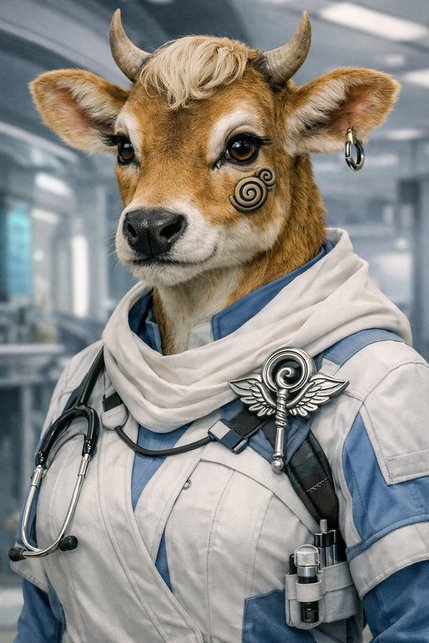 Grazerite medical traditions
Grazerite medical traditions are among the most compassionate and spiritually grounded systems in the Federation — blending herd ethics, biological empathy, and ritualized healing. Medicine for Grazerites is not just science; it’s a sacred act of protection, rooted in the Watcher’s Eye philosophy of vigilance and care.
Foundations of Grazerite Healing
- Herd-Care Principle — Health is communal. Every Grazerite’s wellbeing contributes to herd stability, so healers treat both individuals and their social bonds.
- Vigilance Doctrine — Prevention is the highest form of healing. Regular check-ins, scent-based diagnostics, and emotional resonance readings are part of daily life.
- Empathic Medicine — Healers use pheromonal cues and subtle vocal harmonics to calm patients, aligning heart rate and breathing before treatment begins.
Medical Physiology and Adaptation
Grazerite biology shapes their medical practice:
- Dual-circulatory awareness — Their twin-chambered hearts require precise rhythm monitoring; medics are trained in harmonic pulse therapy.
- Thermal regulation care — Fur and skin cooling systems are treated with mineral balms derived from highland moss.
- Nutrient resonance therapy — Instead of chemical infusions, Grazerite medics use bio-vibrational fluids that restore herd pheromone balance.
Symbols and Uniforms
- Watcher’s Crook Brooch — A spiral set into a shepherd’s crook, worn by medics and protectors. It represents vigilance turned toward safety rather than defence.
- Covered Garments — Medical robes are tailored to Grazerite anatomy, modestly covering udders and emphasizing hygiene and respect.
- Blue-White Colour Scheme — Blue for calm, white for purity, bronze accents for continuity of care.
Healing Spaces
Grazerite medical centers are designed as sanctuaries rather than clinics:
- Circular wards mirror herd formations, allowing patients to see one another and feel communal reassurance.
- Wind-harps and low-light spirals create soothing ambient sound and motion.
- Medic gardens grow herbs from every clan region — moss from highlands, aloe from deserts, and pollen from forest canopies.
Training and Ethics
- Watcher’s Oath — “To see, to guard, to heal.” Every medic recites this before their first patient.
- Herd Empathy Trials — Trainees spend a season living among different clans to understand diverse physiologies and emotional patterns.
- Silent Vigil Practice — Medics meditate in silence before major surgeries, aligning their focus with the herd’s rhythm.
Dual Role: Healers and Protectors
In Grazerite society, medics often serve as peacekeepers:
- The same Watcher’s Crook brooch marks both medical and police professions — symbolising protection through vigilance.
- Field medics accompany scouts and diplomats, trained in both first aid and de-escalation.
- Guardian medics oversee herd safety during migrations and festivals.
Federation Integration (By 2293)
Grazerite medicine is now studied across the Federation for its bio-empathic diagnostics and non-invasive therapies. Their healers are renowned for treating trauma through communal resonance, not isolation — a philosophy that has influenced Federation mental health protocols
Grazerite Biology and Psychology
Biological Profile of the Grazerites
Evolved from herd-dwelling ungulates on the temperate world of Grazer.
- Herd Physiology — Their cardiovascular system is optimized for sustained exertion rather than bursts of speed. A Grazerite can jog for hours but cannot sprint like a Klingon or Andorian.
- Panoramic Vision — Their wide-set eyes give them a nearly 300-degree field of view. This makes them exceptional situational monitors in starship operations and planetary logistics.
- Stress-Diffusion Hormones — Instead of adrenaline spikes, they release a hormone analogous to oxytocin that suppresses panic and encourages group cohesion.
- Ruminant-Derived Digestion — Their multi-chamber stomachs allow them to metabolize a wide range of plant matter, including fibrous alien crops. This made them early agricultural innovators.
- Defensive Morphology — Horn ridges or keratin plates remain vestigial in most modern Grazerites, but ceremonial combat traditions still reference them.
Biological takeaway: Grazerites are built for endurance, awareness, and collective survival, not predation or dominance. This shapes everything else about them.
Psychological Profile
Grazerite psychology is not submissive or timid—it is collective, risk-averse, and consensus-driven, with deep evolutionary roots.
- Distributed Threat Assessment — They instinctively share information and expect others to do the same. Secrets feel biologically “wrong.”
- Consensus Reflex — In a group, they naturally synchronize posture, tone, and decision-making. This is not conformity; it is coordination.
- Low Aggression Baseline — Anger is rare and usually expressed as withdrawal rather than confrontation.
- High Empathic Resonance — They are not telepaths, but their body language and pheromonal cues make emotional states unusually transparent to one another.
- Catastrophe Memory — Their species retains a strong cultural memory of predation. They are excellent planners because they assume threats are real even when unseen.
Psychological takeaway: Grazerites are the Federation’s masters of quiet stability—the species that keeps the room calm while everyone else argues.
Cultural Foundations on Grazer
Grazerite culture is built around the idea that the herd survives together or not at all.
- Communal Agriculture — Land is rarely privately owned. Farming cooperatives dominate rural life.
- Rotational Leadership — Leaders serve short terms and are expected to step down before becoming entrenched.
- The Watcher Tradition — Every community assigns “Watchers” who maintain vigilance during festivals, migrations, or crises. This role is ancient and deeply respected.
- Harmony Rituals — Collective singing, rhythmic stomping, and synchronized breathing exercises reinforce group cohesion.
- Avoidance of Waste — Wastefulness is considered a moral failing; efficiency is a cultural virtue.
Cultural takeaway: Grazerite society is not authoritarian—it is mutually reinforcing, like a well-coordinated flock that moves as one without needing a shepherd.
Grazerites in the Federation (By 2293)
As relatively new members, Grazerites bring a stabilizing but often underestimated presence to the Federation Council.
Their “cattle mentality” manifests as:
- Collective Diplomacy — They rarely speak as individuals. A Grazerite delegation will caucus internally until they have a unified position.
- Process Over Personality — They distrust charismatic leaders and prefer procedural safeguards.
- Long-Horizon Thinking — They support policies that pay off in decades, not years—terraforming, ecological restoration, slow diplomacy.
- Quiet Influence — They rarely take the spotlight, but they are often the swing votes that stabilize coalitions.
- Predator-Memory Politics — They are cautious around Klingons, Nausicaans, and other historically aggressive species—not hostile, but hyper-aware.
How other species perceive them:
- Humans see them as calm and reasonable.
- Vulcans appreciate their predictability.
- Andorians find them frustratingly slow.
- Tellarites think they avoid arguments “like prey animals,” which Grazerites consider a compliment.
- Klingons respect their endurance and loyalty, even if they find their caution alien.
The Grazerite Pressure Point in Federation Politics
By 2293, the Federation is strained by post-Dominion War reconstruction, Romulan refugee crises, and rising border tensions. Grazerites become:
- the Federation’s conscience, reminding others of long-term stability
- the coalition glue, preventing political fragmentation
- the quiet alarm system, sensing when tensions are rising before others notice
Their presence is subtle but essential—like the herd animal that notices the predator before anyone else.
Senator Rafino Anyak
Anyak is a young, eager (for a Grazerite) politician. He has been in the Federation council as the representative of the Grazerite people for three years. He has fallen in with the Betazoid senator Besh, the two of them agreeing that the Federation needs to be re-imagined ready for the new Century, ceasing to be the two-tier organisation looking after the founder members first and the rest later.
Like Besh, Anyak sees Starfleet as being the diplomatic, exploration and scientific arm of the Federation. Military action is something distasteful and seen as a failure of Federation policy. Diplomacy has been seen as a success story along the Tholian border, a success to be repeated in the Beta Quadrant.
Professor Onyk Relefis
Professor of agricultural sciences at the University of Grazer. An expert in the field of crops and farming worlds. Relefis devised the strategy and techniques for restoring Nimbus III after the publicity of 2287. His techniques were also applied to Alpha Venturi Prime and Kronos after their ecological disasters. Relefis has given lectures across the Federation and beyond. Due to his knowledge and successes so far, Starfleet Security has assigned a detail to protect the Professor as it is known there are terrorist groups interested in obtaining the professor for the right price.
Grazer Farming Services
One of the largest agricultural delivery services in the Federation. Specialising in crops, seeds and agricultural technology, GFS has the largest fleet of specialist cargo ships for the job, with unique NGFS registrations. Led by Umooko Noomo, GFS has cornered the agricultural market across the Federation, securing an unassailable position for the opening decades of the twenty-fourth Century.



